
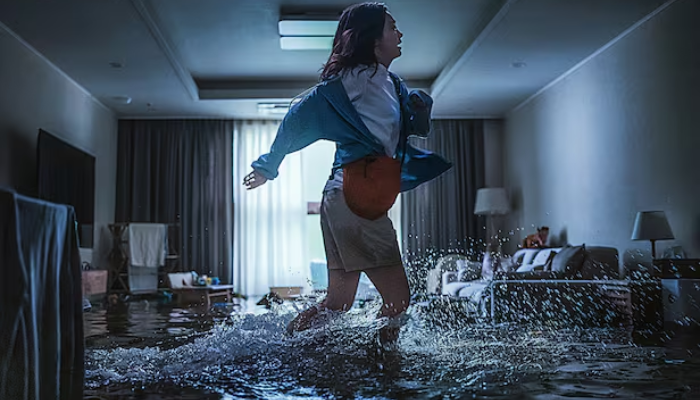

A movie that begins as a straightforward survival story but gradually becomes something much stranger can be difficult to review without giving away too much. That is exactly what makes the great flood reviews so interesting. The Korean Netflix film the great flood reviews starts with a terrifying flood overwhelming Seoul and follows An-na, an AI researcher, and her young son as they struggle to survive. As the story develops, however, the movie moves beyond conventional disaster-film territory and introduces science-fiction ideas that change how the earlier events can be understood.
Directed by Kim Byung-woo and starring Kim Da-mi and Park Hae-soo, the great flood reviews was released on Netflix in December 2025. It has attracted divided reactions, with critics and viewers praising its visual scale, action sequences, and ambition while questioning its increasingly complicated storyline.
This article looks at the major points behind those reactions, including the story, acting, visuals, science-fiction elements, pacing, ending, and the reasons the movie works for some viewers but not for others.
What Is the great flood reviews About?
the great flood reviews is a Korean science-fiction disaster thriller centered on An-na, an AI researcher, and her young son Ja-in. Their situation becomes desperate when catastrophic flooding transforms Seoul into a dangerous environment. As water rises through buildings and normal systems begin to fail, survival becomes a race against time.
The film initially appears to follow a familiar disaster-movie structure. There is a mother trying to protect her child, people attempting to escape a collapsing environment, and a rapidly worsening natural catastrophe. That early setup is one reason several reviews describe the opening as tense and effective. The Guardian, for example, noted that the movie begins like a conventional apocalypse story before moving into more unusual science-fiction territory.
Without spoiling the major revelations, the movie eventually asks larger questions about artificial intelligence, humanity, survival, and what it means to preserve human qualities in a technological future. This shift is central to understanding why reviews of the film are so divided.
The Great Flood Reviews: What Critics Are Saying
The critical response has generally been mixed rather than uniformly positive or negative. Rotten Tomatoes lists the film at 60% from 25 critics, while its audience score on the site is lower. Metacritic’s available critic reviews also reflect reservations about the film’s increasingly complicated second half.
One repeated point in the great flood reviews is that the movie is ambitious. It does not want to remain only a flood-survival thriller. Instead, it combines disaster spectacle with science fiction, mystery, action, and questions about artificial intelligence. That combination gives the film a distinctive identity, but it also creates storytelling problems.
The Guardian described the movie as enjoyable in places but criticized the brittleness of its storytelling. Variety similarly highlighted the amount happening on screen while arguing that the later sections become overloaded with confusing layers.
Other reviewers have been more appreciative of the film’s ambition. Some audience reactions suggest that viewers who enjoy puzzle-like science fiction may find more to appreciate in the movie than people expecting a conventional disaster story. This difference in expectations is important when interpreting the reviews.
How Are the Performances and Characters?
Kim Da-mi carries much of the film through her performance as An-na. The character has to work both as a frightened mother facing an immediate physical threat and as someone connected to the movie’s larger technological mystery. Reviews have generally recognized the strength of the central performances even when criticizing the screenplay.
An-na is particularly important because the emotional core of the movie depends on her relationship with Ja-in. The flood creates physical danger, but the story also uses the mother-and-child relationship to give the larger science-fiction concepts an emotional dimension.
Park Hae-soo also plays an important role as Hee-jo, a figure connected to An-na’s attempted escape and the larger mission surrounding her. The supporting cast helps maintain the tension as the story expands beyond the apartment complex and into a much larger mystery.
For viewers, the performances may be one of the easier aspects of the movie to appreciate. Even reviews that criticize the plot frequently acknowledge that the actors help keep the story watchable.
Are the Flood Scenes and Visual Effects Good?
The disaster sequences are among the clearest strengths discussed in the great flood reviews. The film creates a threatening environment in which ordinary spaces become increasingly dangerous as the water rises. Apartment corridors, stairways, rooms, and escape routes take on a completely different character once they begin filling with water.
The South China Morning Post praised the opening for being breathlessly tense and pointed to the impressive digital effects. Moneycontrol likewise described the film as visually striking and tense, particularly during its early disaster sequences.
The visuals also help establish the scale of the catastrophe. Rather than presenting the flood simply as background scenery, the movie repeatedly makes water an immediate obstacle. Characters have to climb, swim, escape, and make difficult decisions as their environment changes.
That visual strength matters because the movie’s story becomes more complicated later. Even when viewers are uncertain about exactly what is happening, the physical danger can remain easy to understand. The result is a film that can still provide action and spectacle even when its narrative becomes harder to follow.
Why Does The Story Become So Confusing?
This is probably the biggest issue raised by negative and mixed reviews. The movie begins with a relatively accessible premise: a mother and child are trapped during an enormous flood. Viewers can immediately understand the stakes. But as additional science-fiction concepts appear, the film becomes less straightforward.
The second half introduces ideas that require viewers to rethink what they have seen. That kind of storytelling can be rewarding when the pieces eventually fit together clearly. However, several critics felt that the great flood reviews introduces too many concepts without explaining them sufficiently.
India Today described the movie as initially gripping but argued that its move into unclear science-fiction territory weakens its emotional focus. Variety similarly criticized the film for having too many confusing layers in its latter portion.
This does not necessarily mean the movie has nothing to say. Rather, the problem for some viewers is how those ideas are communicated. Someone who enjoys interpreting complicated science-fiction stories may find the ambiguity interesting. Someone looking for a simple disaster thriller may find the same material frustrating.
the great flood reviews Ending Explained Without Major Spoilers
The ending is one of the main reasons viewers search for the great flood reviews after watching the movie. The story deliberately changes the viewer’s understanding of what is happening, so questions about the final revelations are natural.
A spoiler-free way to approach the ending is to see it as a continuation of the film’s central questions rather than simply the conclusion of the flood itself. The movie gradually moves from physical survival toward questions involving artificial intelligence, human behavior, memory, and the possibility of preserving humanity under extreme circumstances.
Because the film’s later developments are designed to alter the interpretation of earlier events, explaining every detail would remove much of the experience for first-time viewers. What can be said is that the ending follows the movie’s decision to become a science-fiction puzzle rather than returning completely to the straightforward disaster formula established at the beginning.
Some viewers have responded positively to that change, while others have felt that the final revelations make the story unnecessarily complicated. The difference largely comes down to expectations. If you expect a conventional flood movie, the ending may feel like a major departure. If you approach it as high-concept science fiction, its later ideas may make more sense.
Is the great flood reviews Worth Watching?
Whether the great flood reviews is worth watching depends heavily on what you want from a movie. The available reviews show that there is no simple consensus. Rotten Tomatoes currently lists a 60% critic score, while Metacritic’s available user reviews place the film in the mixed-or-average range.
Viewers who enjoy Korean thrillers, disaster movies, artificial-intelligence stories, and unexpected genre changes may find the film appealing. Its strongest qualities include its tense opening, visual effects, central performances, and willingness to experiment with its premise.
On the other hand, viewers who prefer tightly explained plots may have a harder time with it. Several reviews specifically mention the confusing second half, and some audience reactions describe the film as difficult to understand or overly complicated.
The safest expectation is therefore to think of the great flood reviews as more than a traditional flood-disaster movie. It starts with survival but eventually becomes a science-fiction mystery. Going into it with that expectation can make its unusual structure easier to appreciate.
Conclusion
The most useful takeaway from the great flood reviews is that the great flood reviews is an ambitious Korean science-fiction thriller that does not stay within the boundaries of a conventional disaster film. Its flooded Seoul setting, tense survival sequences, visual effects, and central performances provide a strong foundation, particularly during the opening portion.
Its biggest point of disagreement is the story itself. Critics and viewers have responded differently to the movie’s transition from disaster drama into complicated science fiction. Some appreciate the ambition and deeper ideas, while others feel that the increasingly complex narrative weakens the emotional impact.
Ultimately, the great flood reviews is best approached with an open mind. It offers plenty of action and suspense, but its real identity lies in the questions it raises about technology, humanity, and survival. Anyone expecting a straightforward flood movie should know that the film eventually takes a much more unusual route.
FAQs
Is The Great Flood a Korean movie?
Yes. the great flood reviews is a Korean film directed by Kim Byung-woo. It stars Kim Da-mi, Park Hae-soo, and Kwon Eun-seong and was released on Netflix in December 2025.
What is The Great Flood about?
The film follows AI researcher An-na and her young son Ja-in as they attempt to survive catastrophic flooding in Seoul. The story later expands into science-fiction territory involving larger questions about technology and humanity.
Is The Great Flood a disaster movie?
It is partly a disaster movie, but it also combines science fiction, action, drama, mystery, and thriller elements. The opening focuses strongly on survival during the flood before the story develops into a more complex science-fiction narrative.
Why are The Great Flood reviews so mixed?
The main disagreement concerns the movie’s shift in direction. Many reviews appreciate its visuals, tension, and ambition, while others believe that the science-fiction elements introduced later make the story confusing or overcomplicated.
Who stars in The Great Flood?
The main cast includes Kim Da-mi as An-na and Park Hae-soo as Hee-jo, with Kwon Eun-seong playing Ja-in. The film was directed by Kim Byung-woo.
Is The Great Flood available on Netflix?
Yes. The Great Flood was released for streaming on Netflix on December 19, 2025.
Does The Great Flood have a complicated ending?
The later part of the film introduces science-fiction concepts that change how viewers interpret the story. Because of this, the ending can feel complicated, especially for viewers expecting a conventional disaster thriller. Critics have specifically noted the film’s increasingly layered second half.