
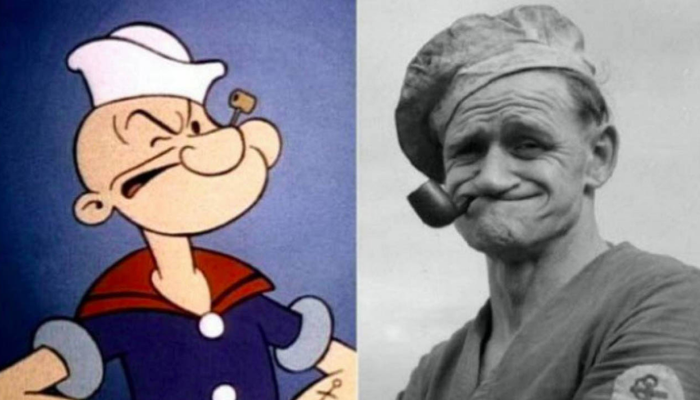

Before Popeye became one of the world’s most recognizable cartoon characters, there was Frank “Rocky” Fiegel, a real man from Chester, Illinois. His story is surrounded by local memories, historical accounts, and a few details that remain uncertain, but his connection to Popeye has become an enduring part of Chester’s identity.
Fiegel is widely regarded as the real-life inspiration for Popeye, the sailor created by cartoonist E. C. Segar. Accounts of his appearance, tough reputation, pipe-smoking habit, and fondness for children helped create striking parallels with the fictional character. At the same time, some popular stories about Fiegel have been repeated so often that it can be difficult to separate documented information from local legend.
This article explores who Frank Fiegel was, how he became associated with Popeye, what is actually known about his life, and why his story continues to attract attention decades after his death.
Who Was Frank Fiegel?
Frank “Rocky” Fiegel was a longtime resident of Chester, Illinois, the same community where E. C. Segar grew up. Fiegel became known locally as a tough, physically strong man with a reputation for getting into fights. Historical accounts also describe him as a laborer and a colorful local character whose appearance and personality made him memorable to people in the town.
Several descriptions of Fiegel closely resemble familiar features of Popeye. He was reportedly associated with a pipe, had a prominent chin, and was known for his rough manner. One particularly interesting part of the story is the contrast between his reputation as a fighter and reports that he was kind toward children and sometimes gave them candy or treats. That combination of toughness and friendliness makes the comparison with Popeye especially memorable.
The details of Fiegel’s early life are less certain than the stories surrounding his years in Chester. Some sources identify him as having Polish roots, with his parents coming from Poland before the family settled in the United States. However, accounts of his occupation and early years sometimes differ, which is why it is useful to distinguish established historical information from stories passed down through local tradition.
How Frank Fiegel Became Linked to Popeye
The connection between Frank Fiegel and Popeye begins with E. C. Segar, the cartoonist who created Popeye. Segar was raised in Chester and drew inspiration from people and personalities he encountered during his youth. Popeye first appeared in Segar’s Thimble Theatre comic strip in January 1929.
According to accounts from Chester and later historical discussions, Segar remembered Fiegel when developing the character. Fiegel’s reputation as a fighter, his physical appearance, and his pipe-smoking image are among the characteristics commonly cited as influences on Popeye. The fictional sailor, of course, was not a literal biography of Fiegel. Segar transformed familiar traits from a real person into a completely fictional character with his own adventures, relationships, humor, and exaggerated strength.
This distinction is important. Saying that Frank Fiegel inspired Popeye does not mean that everything Popeye did happened to Fiegel. Popeye was a work of fiction, and Segar developed the character far beyond the qualities of any one individual. The connection is best understood as artistic inspiration rather than a direct retelling of one man’s life.
What Did Frank Fiegel Have in Common With Popeye?
The similarities between Frank Fiegel and Popeye are one reason the story has remained so fascinating. Fiegel was remembered as a physically tough man who was not afraid of confrontation. Popeye, similarly, became famous for his willingness to stand up to stronger opponents and defend the people he cared about.
Fiegel’s reported appearance also contributed to the comparison. Descriptions of him mention a prominent chin, a pipe, and an unusual facial appearance. Popeye was drawn with an exaggerated chin, a pipe, and a distinctive squint. These visual similarities made the connection particularly easy for later generations to recognize.
There was also a softer side to the story. Accounts say Fiegel was kind to local children and gave them sweets, including children who knew Segar. That detail adds an interesting dimension because Popeye, despite his rough exterior, was frequently portrayed as someone who cared deeply about others.
Still, some famous elements of Popeye’s identity clearly belonged to the cartoon world. Fiegel was not the spinach-powered sailor of the comics, and sources disagree about whether he actually spent significant time at sea. Some accounts describe him as a sailor, while others specifically caution that he was not a sailor and emphasize his life as a Chester laborer.
Was Frank Fiegel Really the “Real Popeye”?
Calling Frank Fiegel the “real Popeye” is convenient, but it can also be misleading. He was a real person who is widely believed to have influenced Popeye, rather than a real version of the fictional sailor who lived the same adventures.
The strongest part of the connection comes from the combination of local tradition and descriptions of Fiegel that closely match Popeye’s early appearance and personality. Chester sources have long recognized Fiegel as the model for Popeye, and the town’s history continues to celebrate the relationship between Segar, Fiegel, and the famous comic character.
There are also misleading photographs online that have sometimes been identified as pictures of Frank Fiegel. Fact-checking investigations have shown that at least one widely circulated image actually depicts a British sailor and not Fiegel. This is an important reminder that viral images should not automatically be treated as historical evidence.
For readers researching Frank Fiegel, the safest approach is to separate three things: what historical sources report about Fiegel, what Chester’s local tradition says about him, and what later writers have added to the story. That approach makes the story more interesting, not less, because it shows how a real local figure became part of global popular culture.
Frank Fiegel’s Later Life and Death
Frank Fiegel remained a local figure in Chester long after Popeye’s debut. The character became increasingly popular, eventually moving from a supporting role in Thimble Theatre to the center of the comic strip. Popeye’s popularity grew rapidly, while Fiegel continued living an ordinary life far away from the international fame of the fictional character associated with him.
Fiegel died on March 24, 1947, at the age of 79, according to commonly cited biographical records. His original grave was reportedly unmarked. Decades later, interest in his connection to Popeye led to efforts to recognize him, and a gravestone featuring an image of Popeye was installed in 1996.
That gravestone became more than a memorial to an individual. It also became a physical reminder of the unusual path by which an ordinary man from a small Illinois town became associated with one of the most famous comic characters in history.
Why Frank Fiegel’s Story Still Matters Today
Frank Fiegel‘s story remains interesting because it demonstrates how ordinary people can influence creative works in ways they never could have predicted. E. C. Segar did not simply invent every aspect of Popeye from nothing. Like many artists, he drew inspiration from people, places, personalities, and experiences around him.
The story also helps explain why Chester, Illinois, has such a strong relationship with Popeye. The town celebrates Segar’s connection to the community and has developed the Popeye & Friends Character Trail, featuring statues dedicated to Popeye and other characters associated with the comic strip.
For modern readers, Frank Fiegel offers an interesting lesson about the relationship between fact and fiction. A local man known for his toughness became connected to a fictional sailor who eventually became a worldwide cultural icon. Yet the real Fiegel had a life that was much more ordinary, complicated, and uncertain than the cartoon version suggests.
That is precisely what makes the story worth remembering. Popeye may belong to popular culture, but the person believed to have helped inspire him belonged to a real community, where people knew him as Rocky rather than as a cartoon hero.
Frank Fiegel’s Lasting Legacy as Popeye’s Inspiration
Frank Fiegel never created Popeye, drew a comic strip, or became a celebrity in the traditional sense. His importance comes from being remembered as one of the people who helped shape E. C. Segar’s imagination. Through Popeye, characteristics associated with Fiegel were transformed into a character recognized around the world.
The legacy has also become part of Chester’s cultural identity. Visitors interested in Popeye’s origins can find reminders of Segar and the people who inspired characters in his comic world. Fiegel’s association with Popeye therefore lives on not only through articles and stories but also through the town that remembers him.
Perhaps the most interesting part of the story is that Fiegel did not need to be exactly like Popeye for the connection to matter. Real people are rarely as simple as fictional characters. A man remembered for toughness could also be kind to children. A local character could become the inspiration for a worldwide icon. And a life that might otherwise have disappeared into history can survive through art.
Frank Fiegel’s name may not be as instantly recognizable as Popeye’s, but his story adds a fascinating human layer to the history of the famous sailor. It reminds us that behind many fictional characters are observations of real people, and sometimes those small observations can last for generations.
Conclusion
Frank Fiegel is widely remembered as the real-life inspiration behind Popeye, particularly because of his connection to E. C. Segar’s hometown of Chester, Illinois and the striking similarities between Fiegel’s reported personality and Popeye’s early characterization. His reputation as a tough local figure, distinctive appearance, pipe, and reported kindness toward children all contributed to the enduring legend.
At the same time, it is important not to treat every popular story about Fiegel as established fact. Some details of his life remain uncertain, and several stories have been repeated or embellished over the years. What can be said with confidence is that Fiegel became an important part of the historical story surrounding Popeye and Chester.
The biggest takeaway is simple: Frank Fiegel was not literally Popeye, but he is widely regarded as one of the real people who helped inspire the character. His story shows how a familiar face from a small town can become part of a fictional creation that reaches millions of people around the world.
FAQs
1. Who was Frank Fiegel?
Frank “Rocky” Fiegel was a local figure from Chester, Illinois, who is widely believed to have inspired E. C. Segar’s Popeye. He was remembered for his toughness, distinctive appearance, and pipe-smoking habit.
2. Was Frank Fiegel the real Popeye?
Not literally. Frank Fiegel was a real person believed to have inspired aspects of Popeye’s appearance and personality. Popeye himself was a fictional character created by E. C. Segar.
3. Did Frank Fiegel really smoke a pipe?
Historical and local accounts commonly describe Fiegel as a pipe smoker, which is one of the details frequently cited when explaining his connection to Popeye.
4. Was Frank Fiegel a sailor?
This detail is disputed. Some accounts describe Fiegel as having a maritime background, while other sources specifically state that he was not a sailor. Because the evidence is inconsistent, it is better not to present the sailor claim as certain.
5. When did Frank Fiegel die?
Frank Fiegel is commonly reported to have died on March 24, 1947, at the age of 79.
6. Where did Frank Fiegel live?
Fiegel was associated with Chester, Illinois, the hometown of Popeye creator E. C. Segar. Chester remains closely connected with the history and legacy of Popeye.
7. Why is Frank Fiegel important to Popeye’s history?
Frank Fiegel is important because he is widely regarded as the real-life inspiration for Popeye. His story helps explain some of the character’s physical and personality traits while connecting Popeye’s fictional world to Segar’s childhood community.